
Obsessive-Compulsive Disorder: Info, Strategies, and Resources for Parents & Families
Living with and/or parenting someone with OCD can be exhausting. The things their OCD wants them to do can be irrational. annoying, and time-consuming. And unfortunately, the natural, kind ways that we want to respond - helping them, reassuring them, doing things that can immediately reduce their anxiety - can actually increase their distress in the long run. Here is the information that I like to share with parents and family members of clients with OCD (and other anxiety disorders) to help them understand what is going on and what their role in treatment will be…
What is OCD and how does it work? Why does it get so bad?
First, some quick definitions:
Obsessions are persistent, recurring, unwanted thoughts. These are unique to each individual, but some of the common obsessions are around hygiene/health (thinking about germs, sickness), fear of harm (worrying something bad will happen to yourself or others), or symmetry (noticing and obsessing over things that don’t look right or exact). Thoughts that might just pass through someone else’s head - “I wonder if I locked the door. Eh, I probably did, it’s not worth driving back home. No one will try to break in anyways.” - play on an anxious loop with OCD - “I wonder if I locked the door. I need to go check it. If I don’t make sure someone could break in and take my stuff. That would be all my fault. I can’t be sure if I locked it.”
Compulsions are ritual behaviors or thoughts that temporarily relieve anxiety of obsessions. These are the behaviors that you have likely noticed with someone with OCD. They may be washing their hands over and over, checking locks, moving things until they are just right. Family members are often pulled into compulsions, so you may have also been asked to do some checking or wash your hands for longer.
We all have occasional unwanted thoughts and things we do to relieve anxiety. In order to be diagnoses with OCD, these symptoms are persistent, cause distress and anxiety, and interfere with their lives.
In everyday life, exposure helps us manage our anxiety. We may be scared or unsure of spiders the first time we see them, but then we see them more and more times, see other people around them, and our fear becomes more rational.
But OCD undermines this system. For example: You are scared and unsure about spiders. Now imagine I told you that spiders won’t hurt you if you clapped your hands and said a prayer when you saw them. And also try not to think about spiders. This would tell your brain that spiders are really scary, you should be scared of them, and you need to avoid feeling that fear by clapping and praying. You may even start clapping multiple times (even with just the thought of spiders) and adding on and on to your prayers. When you clap, you feel a little bit calmer, but it only confirms to your brain that spiders are scary. And you can never seem to clap enough times to get the thoughts of spiders out of your head.
Avoidance reinforces anxiety, and compulsions are avoidance. When you do a compulsion, you get some relief from your anxiety, which reinforces the compulsions (just like any other reward in life can increase that behavior) and increases your future anxiety.
Here’s an example of how this creates a ‘fear cycle’ that continues to spiral:
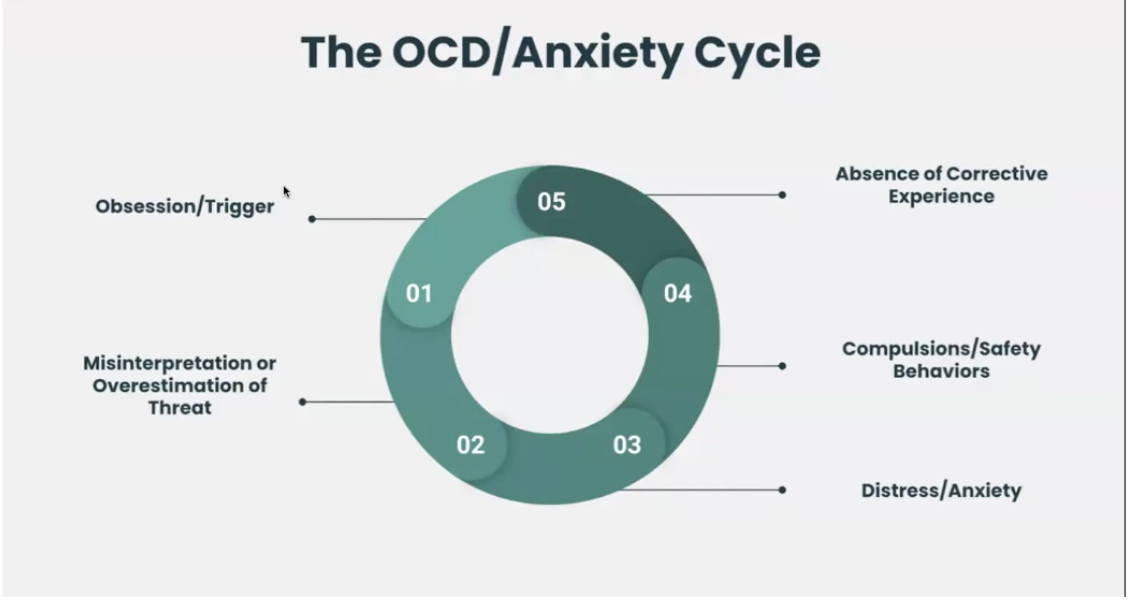
What is Exposure and Response Prevention (ERP)?
ERP is an evidence-based, behavioral therapy that interrupts the cycle of OCD by exposing clients to their stressors and preventing compulsions. We start by identifying your child/teen’s compulsions and creating a hierarchy of those that cause the least to most distress. We’ll also talk about what they value and which areas are most important to them to work on first. Together, we’ll find a starting point, then work through this hierarchy together.
Your child/teen is put into a situation where they are feeling the anxiety of their obsessions, but prevented from completing their rituals. This is hard and distressing for them, but we ask them to remain in that state until their anxiety starts to reduce (practically, this is about 15 minutes). Then we repeat this exposure, and ask them to repeat it on their own at home. Their brain will start to adapt to this exposure, and learn that they can manage the stress of their obsessions (which over time will reduce these thoughts altogether).
Goals of Exposures:
Learn that their anxiety and compulsive urges don’t last forever AND they can manage the stress.
Learn that feared consequences don’t occur.
Exposures should be gradual, cautious, and at a restrained pace
Our goal is for your child/teen to be the one in charge of this process, collaboratively working with us to plan out the exposures.
Be careful not to expect everything to change at once! Focus on the exposure that they are currently working on (expecting too much change too soon may lead them to be more resistant to treatment).
What is Your Role?
Be a part of the intake and treatment planning process. Share your observations, and talk often with your child/teen about how you are looking forward to seeing their lives without OCD.
Help them with exposure homework.
Play your ‘part’ in the exposures. You are likely already a part of their OCD, so we will need you to play a part in their homework. Make time to act out a trigger with them, change your behavior so that you are not accommodating their current exposure homework, or to help them manage or distract them if they ask. This means if you have been checking for them or washing your hands extra times, or reassuring them over and over, you will plan together to stop helping in this way. This can be a really hard thing for you to do - you will have to see them upset and resist the urge to help - be prepared to feel that discomfort yourself!
Your role is to strongly encourage them to withhold the ritual, but no physical force is used and arguments should be avoided. If they fail in completing the exposure, they can just start over and try again, or note whatever progress they did make and try again tomorrow (help them celebrate partial progress!).
You may help distract them with conversation, games, or other activities if they ask, but do this cautiously (exposures tend to work best without distractions). Remember, you do not need to encourage them to stop thinking about their obsessions (the goal of exposure is for them to think about their distressing thoughts!) and you should not distract them with the same things every time (or this may become a compulsion).
Your goal is to offer SUPPORT with Acceptance AND Confidence:
“I know it’s hard, but I know you can handle it.”
Acceptance - acknowledging and accepting that they are afraid
I accept that you are afraid and acknowledge that what you are feeling is real and legitimate. I am not trying to deny your experience or to belittle it.
Reflect their feelings: “I know this is really scary for you…” “You’re feeling overwhelmed…”
Avoid telling them that things are no big deal or they shouldn’t be scared; often a response to this is trying to prove to you that they are afraid, which will often increase anxiety. It’s also usually not helpful to use logic and rational arguments (OCD isn’t rational).
Confidence - let them know you know they can handle this!
I have faith in your ability. I know you can cope and believe you are strong enough to face this challenge successfully.
“I know you can handle it.”
How to Respond When They Are Asking for Reassurance
Asking for reassurance is a common compulsion. When we feel unsure or anxious, we want someone to let us know we’re okay. Unfortunately with OCD, this avoidance strengthens the intrusive thought and need for reassurance again and again and again. That means that with OCD, what is most helpful is to do the really hard thing of not helping someone when they are asking for it (even when it upsets them!). I know this goes against so many kind, caring parental instincts, so it’s helpful to have a script and practice how you will handle these situations.
Here are some recommendations of what this could look like:
“I think your question is actually OCD trying to be sure. Remember, I am not answering any of OCD’s questions so I can help you make your OCD smaller. I know this may feel hard and your anxious feelings bigger, but I know you can handle it and are learning you don’t need to listen to your OCD.”
Label the compulsion or accommodation they are requesting.
Give one brief reminder about why not giving them reassurance is important
Let them know that you understand that they are stressed and this is difficult
Point out their strengths, resilience, and/or how proud you are of them.
Then disengage and move on! You can choose to walk away, move onto another conversation or activity, or just sit with them as they are stressed (but ignore any further attempts on their anxiety).
This response can be difficult to put together in the moment - especially when your child is more upset - so take the time to write it out and practice it! Remember your response should not change based on their level of anxiety; be prepared to stick to your script even when they are upset.
Reference: Lebowitz, E. (2019). Addressing parental accommodation when treating anxiety in children. Oxford University Press, New York, NY.
Helpful Strategies for Parents:
Talk about “your OCD” like a separate person and common enemy.
“Your OCD really wants you to believe that…”
Some kids and teens may want to name or give a personality to their OCD.
Emphasize that they are not in control of their thoughts and don’t need to try to be. Talk about thoughts as interesting things to observe, that don’t have any power to affect the real world (avoid saying things like “that’s awful, don’t even say that!!”).
Remember, reassure only once or not at all. Repeated reassurances can become a compulsion.
Model good stress management. Practice staying calm, using healthy tools like exercise or breathing techniques when stressed, and talk openly about accepting uncertainty with the confidence that you know you can handle it.
Remind them that both ERP and OCD are hard! But ERP can lead to no OCD.
Some Helpful Resources:
Treating Childhood & Adolescent Anxiety: A Guide for Caregivers, by Lebowitz & Omer
Treatments That Work: Treating Your OCD with Exposure and Response (Ritual) Prevention Workbook, by Elna Yadin, Edna B. Foa, & Tracey K. Lichner
OCD can be so overwhelming. I offer a free 20-minute phone consultation for you to ask questions and get a better understanding of my approaches and your treatment options. I’ll help you find the right support for your family (even if it’s not with me!).